This Day in History Entry #47

January 5th, 2010 by Wordsman

Where will his films spirit you away?
The lands of Princess Mononoke?
Or perhaps Totoro
Castles move to and fro
Miyazaki Hayao: born this day

Event: Birth of Japanese animated filmmaker Miyazaki Hayao
Year: 1941
Learn more: http://en.wikipedia.org/wiki/Hayao_Miyazaki

Posted in This Day in History | No Comments »

Bachelor Resolutions

January 4th, 2010 by Wordsman

This post is for all you out there who miss seeing pictures on this site.

In honor of the new year, I thought that it would be a good idea to look around my apartment and come up with a list of laudable things to plan to do but then forget about before February rolls around.  The list is as follows:

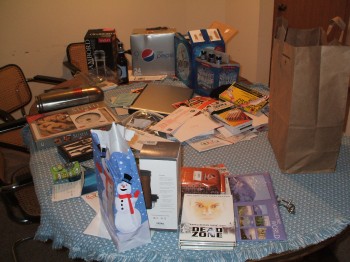
1. Occasionally use dining table for dining (or, failing that, at least for sitting)

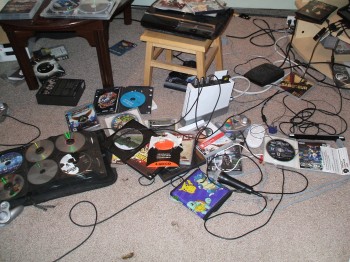
2. Solve disc storage problem

I don't think a single one of these is in its original case

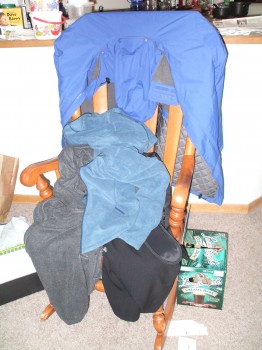
3. Sit in rocking chair

But it makes such a fine coat rack!

4. Never again go into roommate’s bathroom

This one I might actually do if we didn't keep some of the cleaning supplies in there

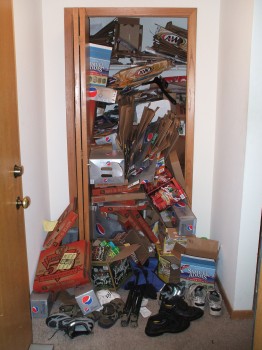
5. Solve cardboard storage problem

People are starting to worry that it will fall and crush them the second they walk through the door

Posted in Uncategorized | 6 Comments »

The Jenoviad Entry #47

January 1st, 2010 by Wordsman

Down from rooftops, through the slums
Which stank of grime and sweat
They passed hovel after hovel
Cloud asked, “Are we there yet?”

Finally they reached a house
With garden, waterfall
“Can this be the slums?” he asked
The place did him enthrall

The girl deigned not to answer
She just went inside, quite calm
“Hello!” she said, and then: “I’m home!
How are you doing, Mom?”

“This is Cloud,” she introduced
“He’s been my bodyguard”
“WHAT?  Now, if I had my way
You’d never leave the yard”

“Oh, Mom!” she said, and then to Cloud:
“She likes to get this way
So!  What do you want to do?
I have no plans today”

Cloud could think of one good thing
But her mom was nearby
“Maybe I should see Tifa
She was worried I’d die”

Aeris looked suspicious
But then she just said, “Okay”
“It is in Sector Seven”
“Oh yeah, sure, I know the way”

Posted in The Jenoviad | No Comments »

Movie Two-Liners Entry #46

December 30th, 2009 by Wordsman

This week’s puzzle:

Two young men get into fights with their peers, one because of his mother and the other because of his father. Later on, one of them tells the other that the only way to save the day is for them to fight each other.

Last week’s puzzle:

A man with a gift for language acquires the thing that he treasures most but loses it in circumstances that will never be fully explained. As if this were not bad enough, he must endure a family member with a dangerous obsession, a pack of marauding animals, and the difficulties of multicultural celebratory rituals.

And the answer is . . . ▼

Posted in Movie Two-Liners | No Comments »

This Day in History Entry #46

December 29th, 2009 by Wordsman

Thomas proved to be Henry’s black beast
But did he really want him deceased?
Four knights him overheard
Took him just at his word
And rid him of that turbulent priest

Event: Assassination of Thomas Becket, Archbishop of Canterbury
Year: 1170
Learn more: http://en.wikipedia.org/wiki/Thomas_Becket#Assassination

Posted in This Day in History | 2 Comments »

Brevity=Wit Entry #8

December 28th, 2009 by Wordsman

Do you know what I miss?  I miss big opening speeches.  Nowadays it seems like everyone prefers to start off a story by just throwing you into the middle of it and letting you figure out what’s going on as things transpire.  Whatever happened to the storyteller, the almighty omniscient narrator, the unquestionable figure who appears in the beginning and definitively sets the stage for us all?

William Shakespeare knew how to do it.  Now there was a man who could open his plays with a great starting speech.  Let’s take a look at one of his most famous, the starting monologue from Romeo and Juliet:

“Two households, both alike in dignity,
In fair Verona, where we lay our scene,
From ancient grudge break to new mutiny.
Where civil blood makes”

Huh.  Wow.  Yeah, that opening speech was a lot longer than I remembered.  Setting the scene is all well and good, but come on, let’s see a little concision here!  If you’re going to begin with talking rather than action, you’ve got to make sure you wrap it up before you lose everyone’s attention.  We’re told about the feuding families, which is important, but I always thought that Romeo and Juliet was about, you know, Romeo and Juliet.  Our famous star-crossed lovers don’t appear in this intro.  And Heaven help you if you want to know what civil blood makes.  I can’t tell if the last line sounds like it should be a proverb or a Zen riddle.  Civil blood makes . . . civil neighbors?  Waste?  A man healthy, wealthy, and wise?  The sound of one hand clapping?

This thing definitely needs saving.  Let’s see if we can cut it down:

“Two classy families in Verona hate each other.  Two of their kids don’t, but they’re doomed.  When they kill themselves it fixes everything.”

Tada!  All the vital information, quick and easy.  Sure, it gives away the ending, but you’ve got to remember that this play predates the spoiler warning by several centuries.  When they call it The Tragedy of Romeo and Juliet, nobody’s expecting them to have kids and live to a ripe old age.  Anyway, with this we are able to finish the opening quickly and move on to the real meat of the play: puns on the carrying coals/colliers/choler/collar theme and a veritable rash of thumb-biting.

Posted in Brevity=Wit | 1 Comment »

The Jenoviad Entry #46

December 25th, 2009 by Wordsman

The pair lay there, upon the roof
Recov’ring from distress
“So, why were those guys after you?”
“Just ‘cuz I’m cute, I guess?”

“No, really,” Cloud said, sitting up
“You have misunderstood
The Turks recruit for SOLDIER”
“Well, maybe I’d be good

“Can we not talk about this now?”
She said as she stood up
“I’d really like to just get home
It’s almost time to sup”

The two dashed off, from roof to roof
‘Til Aeris cried out, “Wait!”
Cloud smirked. “You can’t be in SOLDIER
With that slow of a gait”

“How would you know?” Aeris asked
“Were you in SOLDIER? Huh?”
“Well yeah,” said Cloud. “Where do you think
This giant sword’s from? Duh.”

“Oh yeah,” she said, watching his face
“You’ve got those Mako eyes”
“How do you know about that?”
He asked in great surprise

Aeris became flustered
“Oh, uh . . . that was just a hunch
Now come on, Reno’s chasing us
We’re in a real time crunch!”

Posted in The Jenoviad | No Comments »

Movie Two-Liners Entry #45

December 23rd, 2009 by Wordsman

This week’s puzzle:

A man with a gift for language acquires the thing that he treasures most but loses it in circumstances that will never be fully explained. As if this were not bad enough, he must endure a family member with a dangerous obsession, a pack of marauding animals, and the difficulties of multicultural celebratory rituals.

Last week’s puzzle:

A young woman travels from a church to a hospital, two restaurants, and a house via ambulance (presumably), wheelchair, airplane, motorcycle, and wagon. During her journeys, she encounters two females who lost their mothers at a young age, two teachers with problematic students, and a large number of handicapped people.

And the answer is . . . ▼

Posted in Movie Two-Liners | No Comments »

This Day in History Entry #45

December 22nd, 2009 by Wordsman

Though the Germans were kicking their butts
The old One-Oh-First still showed their guts
Asked to give up Bastogne
McAuliffe was not thrown
To the Germans he wrote one word: “NUTS!”

Event: U.S. 101st Airborne refuses to surrender in the Battle of the Bulge
Year: 1944
Learn more: http://en.wikipedia.org/wiki/Anthony_McAuliffe#.22Nuts.22

Posted in This Day in History | No Comments »

Brevity=Wit: Holiday Edition

December 21st, 2009 by Wordsman

With Christmas coming up soon, I felt that it was time to take a look at a holiday classic.  “Account of a Visit from St. Nicholas,” commonly known as “The Night Before Christmas,” is a nice, short poem.  Clement Clarke Moore knew what he was doing; the whole thing can be read in only a few minutes, which is much quicker than all those Christmas carols, where it takes half an hour to remember and agree upon the words to all the obscure verses that no one ever sings.  Truly an exemplar of brevity . . . or, at least, it was in 1823, when it was first published.  Let’s see how it holds up to today’s standards:

“‘Twas the night before Christmas, when all thro’ the house
Not a creature was stirring, not even a mouse;
The stockings were hung by the chimn”

Well that explains why everyone thinks the poem is called “‘Twas the Night Before Christmas.”  It’s the only part that anyone can remember.  I mean, geez Louise, Moore really needs to remember what his priorities are.  He called the thing “Account of a Visit from St. Nicholas,” and the jolly guy himself never even makes it down the chimney (the chimney only barely sneaks in itself).  The author sets a nice scene, but is it really fair that the mouse, without even making a sound, earns more mention than the title character?  Looks like this thing is in need of serious work after all.

I don’t see what Moore’s big problem was.  The substance of the poem can be easily summed up within reasonable limits.  Observe:

“On Christmas Eve, I saw Santa and his reindeer on the roof.  He came down the chimney, laughed, went back up, and wished us well as he left.”

There you go.  Everything you need, right there in just two sentences.  St. Nick gets to play his part, as do the reindeer.  Everyone should be happy.

Of course, there are those who complain that the condensed version lacks the true Christmas spirit, that it lacks “whimsy.”  Let it never be said that I am an unreasonable man.  In response to this objection, I have prepared a second version that both stays within appropriate character limits and maintains the rhythm and rhyme that are what some people believe gives the poem its heart:

“Xmas Eve, quiet, I got up quick
Saw on the roof: ol’ jolly St. Nick
Gave gifts to us, then he took to flight
‘Merry Xmas to all, and also good’”

(NOTE: Sources suggest that St. Nicholas intended to include one additional final word in his parting phrase, but, most regrettably, his sleigh had already passed beyond the narrator’s range of hearing.)

Posted in Brevity=Wit | No Comments »

« Previous Entries Next Entries »